What Good IT Ownership Actually Looks Like
Last post we talked about the cost of unowned IT.
The invisible bleeding. The friction. The questions nobody can answer.
But here's the thing: ownership doesn't mean more bureaucracy.
It means IT stops being a black box and starts being a system.
Ownership Isn't Micromanagement
This is where people get it wrong.
Owning IT doesn't mean:
More meetings More tools More control More approval processes
It means:
One person (or team) who actually owns the decisions Documentation that's useful, not just theoretical Regular review of cost, performance, and risk Someone responsible when things drift
That's it.
What Good Ownership Looks Like in Practice
In healthy environments, IT becomes predictable.
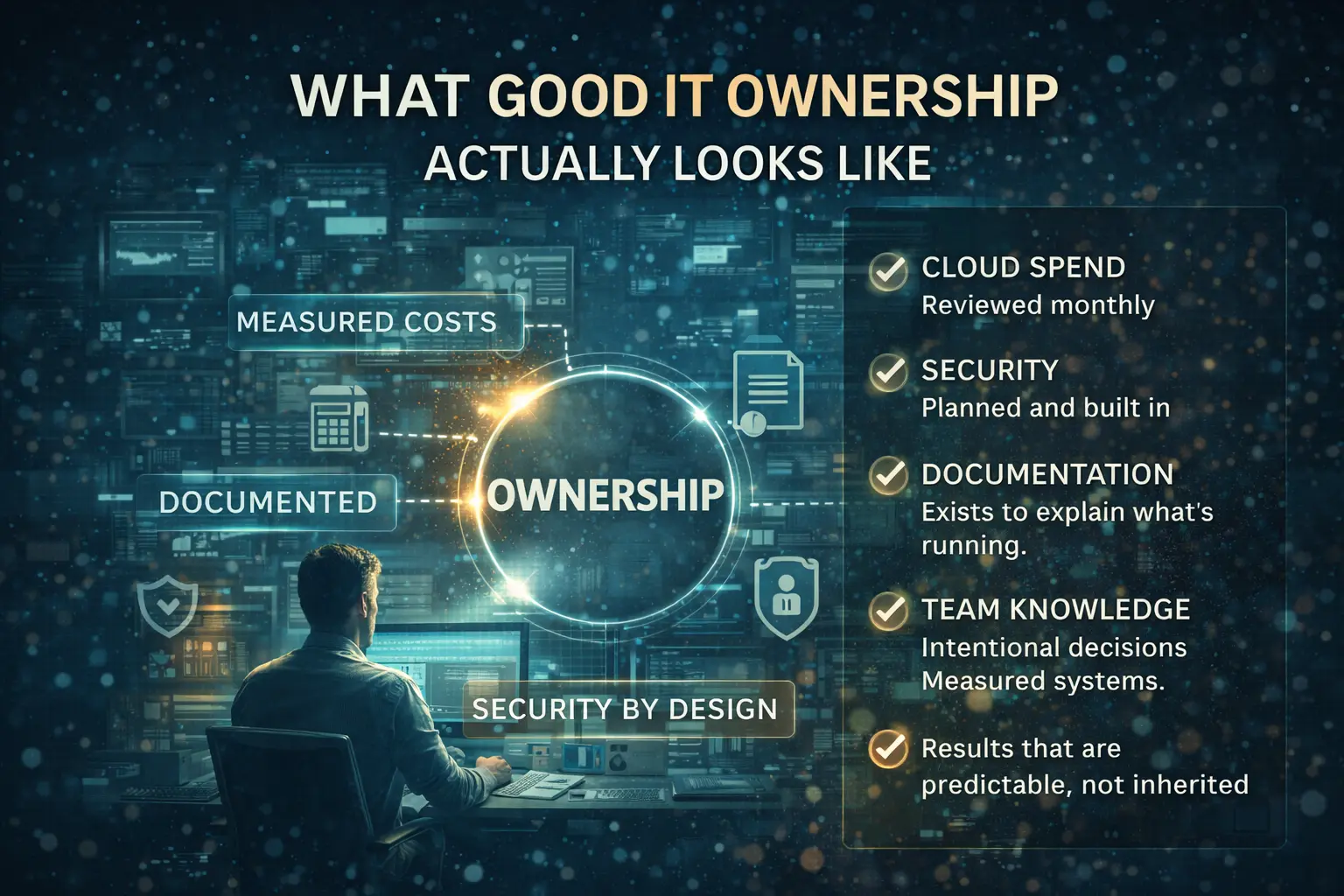
Cloud spend is understood, not guessed at in budget meetings. You know what you're paying for because someone reviews it monthly.
Security is designed into systems, not bolted on as an afterthought. It works because it's intentional, not because you're lucky.
Documentation exists because it's useful. New team members don't have to reverse-engineer how things work.
Decisions are intentional, not inherited. When something changes, someone decided it should, not just… happened.
Systems are measured. You know your cloud efficiency ratio. Your security posture. Your disaster recovery readiness.
IT stops being reactive. It becomes predictable.
And predictability is where savings, sustainability, and resilience actually come from.
Why This Matters for Growth
Here's what most businesses miss:
Good IT ownership doesn't slow you down. It speeds you up.
Because when IT is owned:
New projects don't get delayed while you figure out if your infrastructure can handle them You're not firefighting problems that could have been prevented Decisions don't get stuck waiting for someone to "check with IT" You actually know your costs before they surprise you
Growth happens faster when IT isn't a friction point.
The Role of Modern MSPs Has Changed
This is where MSPs fit in differently now.
A traditional MSP fixes tickets when things break. A modern MSP helps you own the system.
That means:
Designing infrastructure with cost and efficiency built in (not added later) Regular audits of what you're running and why Making IT understandable to non-technical decision-makers Aligning infrastructure with your actual growth and 2030 goals Helping you answer: "Are we set up for what comes next?"
Support is table stakes. Ownership is the real value.
How to Start Owning Your IT (Even If You've Never Done This)
You don't need a total rebuild.
Start here:
Month 1: Get Visibility Pull a full list of what you're actually running. Cloud resources. Software licenses. Infrastructure. Everything. This sounds simple. Most businesses can't do it. That's your starting point.
Month 2: Assign Ownership Pick a person or team responsible for reviewing and approving changes to IT. Not micromanaging day-to-day. Just… owning the strategy.
Month 3: Audit Cost and Performance Look at your cloud bills. Your security tools. Your licensing. What's actually being used? What overlaps? What's costing you more than it should?
Month 4: Document the Decisions Write down why things are the way they are. Not a novel. Just: "We chose AWS because X. We run these tools because Y." This becomes your foundation for future decisions.
Month 5: Schedule Regular Reviews Monthly or quarterly. Depends on your size. Cost. Performance. Security. Growth needs. Same conversation. Same owner. Predictable.
That's it.
In five months, IT goes from "someone else is handling it" to "we actually understand what we're running."
The Businesses Moving Ahead Are Doing This Now
2026 is when clarity becomes a competitive advantage.
The companies that know:
- What they're paying for
- What they're running and why
- Who's responsible
- How it supports their actual business
…are the ones that can answer compliance questions confidently. Scale without chaos. Invest in growth instead of firefighting.
The ones that don't? They'll keep paying invisible costs while wondering why IT feels like a drag.
It's Not About Being Perfect
Good ownership isn't about having everything figured out.
It's about having someone responsible for figuring it out.
Someone who can say:
"Here's what we're running. Here's why. Here's what it costs. Here's how it fits our goals. And here's what changes next."
That clarity—that ownership—is what transforms IT from a cost center into a competitive advantage.
The question isn't whether you can afford to own your IT properly.
It's whether you can afford not to.